
The PPWR sets minimum recycled-content levels for plastic packaging, phased in from 2030 and rising again in 2040, and it counts only post-consumer recycled material toward those targets. That is the rule in one sentence. The rest of this piece is about what it means for the person who has to act on it, because a regulation is only useful once it turns into something you can do on Monday morning.
A quick note on how to read what follows. We have checked the headline figures and dates against current EU sources. Regulation moves, secondary legislation fills in detail, and the exact treatment of a specific product can hinge on definitions that are still settling. Where a number is firm we state it plainly. Where the application to your specific case needs confirming, we say so rather than guess.
What the PPWR actually requires
The Packaging and Packaging Waste Regulation, Regulation (EU) 2025/40, replaces the older packaging directive and applies from 12 August 2026. Among many other things, it sets minimum recycled-content targets for the plastic part of packaging, measured as an average per manufacturing plant per year rather than item by item.
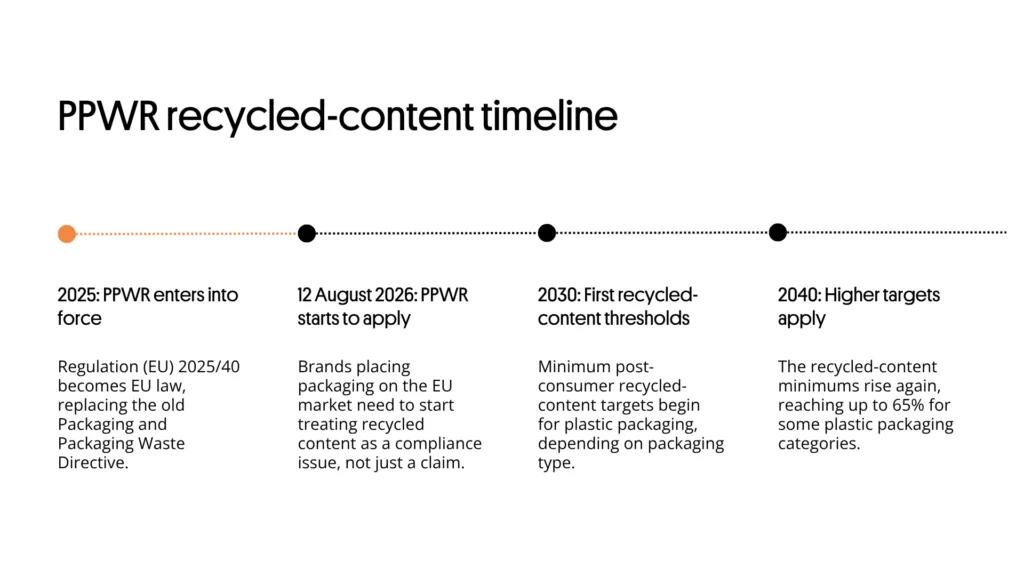
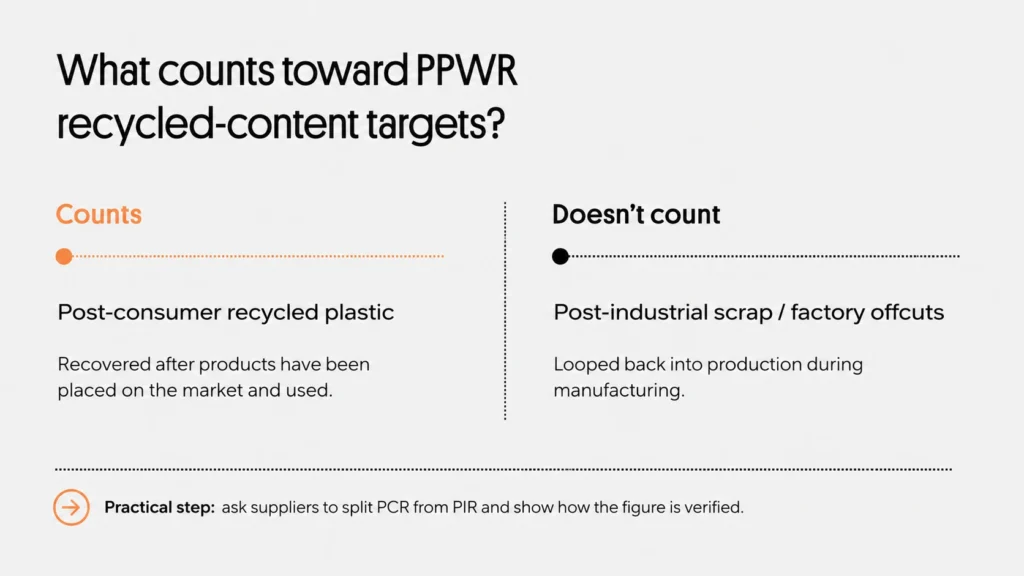
The recycled-content targets come in two waves. From 1 January 2030, plastic packaging must hit minimums that depend on the type of packaging, with contact-sensitive PET packaging and general plastic packaging carrying their own thresholds. From 1 January 2040, those minimums rise substantially. One detail matters more than any single percentage: the regulation counts only post-consumer recycled content. Post-industrial scrap looped back into production does not count toward these targets. If your recycled story relies on factory offcuts, the regulation will not recognise it.
Here is how the percentages currently look:
| Packaging type | 2030 minimum | 2040 minimum |
|---|---|---|
| Contact-sensitive packaging made mainly from PET, except single-use plastic beverage bottles | 30% | 50% |
| Contact-sensitive packaging made from plastics other than PET | 10% | 25% |
| Single-use plastic beverage bottles | 30% | 65% |
| Other plastic packaging | 35% | 65% |
Only post-consumer recycled plastic counts toward these targets, and they are measured as an average per manufacturing plant per year. The real work for most teams is not memorising the numbers, it is mapping each packaging format to the right row, which is where judgement is still needed.
The practical effect is that "recycled" stops being a marketing choice and becomes a measured, post-consumer number you have to evidence. That is a higher bar than most packaging claims have had to clear, and it rewards suppliers who already work with genuinely high post-consumer content.
Where our materials sit
This is where keeping materials distinct pays off. The packaging you put a product in is not the same material as the product itself, and the regulation treats them on their own terms.
Our reusable bags are made from recycled polypropylene, rPP, whose feedstock is post-consumer food containers. Against virgin polypropylene, our rPP uses 88% less energy, 46% less water, and generates 71% less CO₂. The recycled-content point is the one that speaks most directly to PPWR thinking: many competitors satisfy only a 20% recycling requirement, while ours goes well beyond that. In a world where the regulatory floor is rising and only post-consumer content counts, a bag that already runs high on post-consumer rPP is a stronger starting position than one scraping a low threshold.
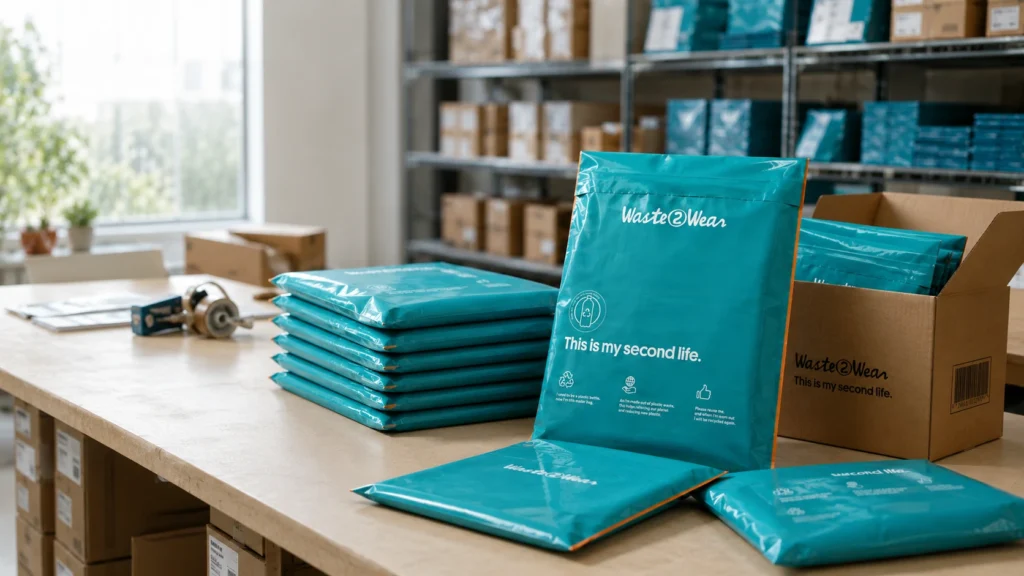
Our delivery mailers are a different material again, recycled low-density polyethylene, rLDPE. It is worth separating in your own compliance thinking, because the mailer that ships an order and the bag a customer reuses are not interchangeable, and a recycled claim on one does not transfer to the other.
And whether you take a recycled material as yarn, fabric, or finished product, the recycled content is documented for what you receive, so the claim is something you can point to rather than something you have to reconstruct later.
What to do on Monday
Translating the regulation into action does not require waiting for every delegated detail to land. A few moves are sensible now.
Separate post-consumer from post-industrial in your data
Only post-consumer content counts toward the targets, so you need to know which of your recycled inputs is which before you can claim anything. If your supplier reports a single blended "recycled" figure, ask them to split it.
Map your packaging formats to categories
The thresholds differ by packaging type, so the first question is which category each of your formats falls into. That is the step most likely to need confirmation against the current text, so treat the category mapping as something to confirm rather than an assumption.
Pressure-test suppliers on evidence, not adjectives
A recycled percentage you cannot evidence is a percentage that will not survive an audit. Ask how the figure is verified and whether it is post-consumer.
Treat the 2030 date as a design deadline, not a reporting one
Packaging decisions made now have a way of locking in for years, so the material choices you make today are the ones that will be in market when the first threshold bites.
If you want a structured way through this, our supplier checklist tool walks the same questions in order, so you can hand it to a buyer or a packaging team and get consistent answers back.
How this connects to the wider picture
PPWR is one pressure among several pushing recycled claims from loose to evidenced, and the thresholds on this page are only half the story. Knowing the percentage you have to hit is the starting point. Being able to prove the percentage you actually have is the harder part, and it is where most of the work sits once the numbers are settled. We have set out the buyer side of that in a fuller guide to the questions to ask a recycled packaging supplier and the evidence a claim should rest on, which picks up where the thresholds leave off.
The same direction of travel runs through verification and through the standards that back a claim, and we hold all of it in one place. Our Proof Hub brings together the verification, impact data, traceability and certification that turn a recycled number into something a buyer or an auditor can stand behind. The throughline is consistent: a recycled number is only worth what its evidence is worth.
FAQ
The PPWR, Regulation (EU) 2025/40, applies from 12 August 2026, having entered into force in early 2025. Many of its detailed requirements, including the recycled-content thresholds, phase in later, with the first recycled-content minimums applying from 1 January 2030 and higher minimums from 1 January 2040. Always confirm the date for your specific obligation against the current text.
No. The PPWR recycled-content targets count only post-consumer recycled material. Post-industrial scrap reintroduced during manufacturing does not count toward the Article 7 thresholds. This is why it matters to separate post-consumer from post-industrial in your own data before making a claim a regulator or buyer will scrutinise.
The targets are tiered by packaging type and rise in two waves. From 1 January 2030 the minimums are 30% for contact-sensitive PET packaging other than beverage bottles, 10% for contact-sensitive packaging made from other plastics, 30% for single-use plastic beverage bottles, and 35% for other plastic packaging. From 1 January 2040 these rise to 50%, 25%, 65%, and 65% respectively. Only post-consumer recycled plastic counts, measured as an average per manufacturing plant per year. The work for most teams is mapping each packaging format to the right category.
Our reusable bags are recycled polypropylene, rPP, and our delivery mailers are recycled low-density polyethylene, rLDPE, which are different materials with different roles. How a given item is classified under the regulation depends on its function and format, so treat the classification of each item as something to confirm rather than assume.
Sources
- European Commission, Packaging and packaging waste — overview of the PPWR, its entry into force and application dates: https://environment.ec.europa.eu/topics/waste-and-recycling/packaging-waste_en
- Regulation (EU) 2025/40 (PPWR), full legal text on EUR-Lex, including the Article 7 recycled-content requirements and the per-plant-per-year basis: https://eur-lex.europa.eu/eli/reg/2025/40/oj/eng