From 27 September 2026, a picture of a leaf on your packaging can count as an environmental claim under EU consumer law. The Empowering Consumers Directive (EU 2024/825) defines environmental claims by what they communicate rather than by whether they use words, so imagery, colours and symbols are all in scope.
Most of the discussion around the directive has focused on banned words such as "eco-friendly" and "climate neutral". That is only half of the picture. A pack can pass a copy review and still carry an implied claim through its design, and the design is often the part nobody has checked.
This article sets out what the directive actually says about images, when an image turns a vague word into a prohibited claim, and how brands can keep their visual identity while meeting the new rules.
What the directive says about images
The directive inserts a definition of "environmental claim" into Article 2 of the Unfair Commercial Practices Directive. It covers any non-mandatory message or representation "in any form, including text, pictorial, graphic or symbolic representation", made in a commercial communication.
The definition then sets the test. The message has to state or imply that a product, brand or trader has a positive or zero impact on the environment, is less damaging than competitors, or has improved its impact over time. Labels, brand names, company names and product names are named as examples of forms a claim can take.
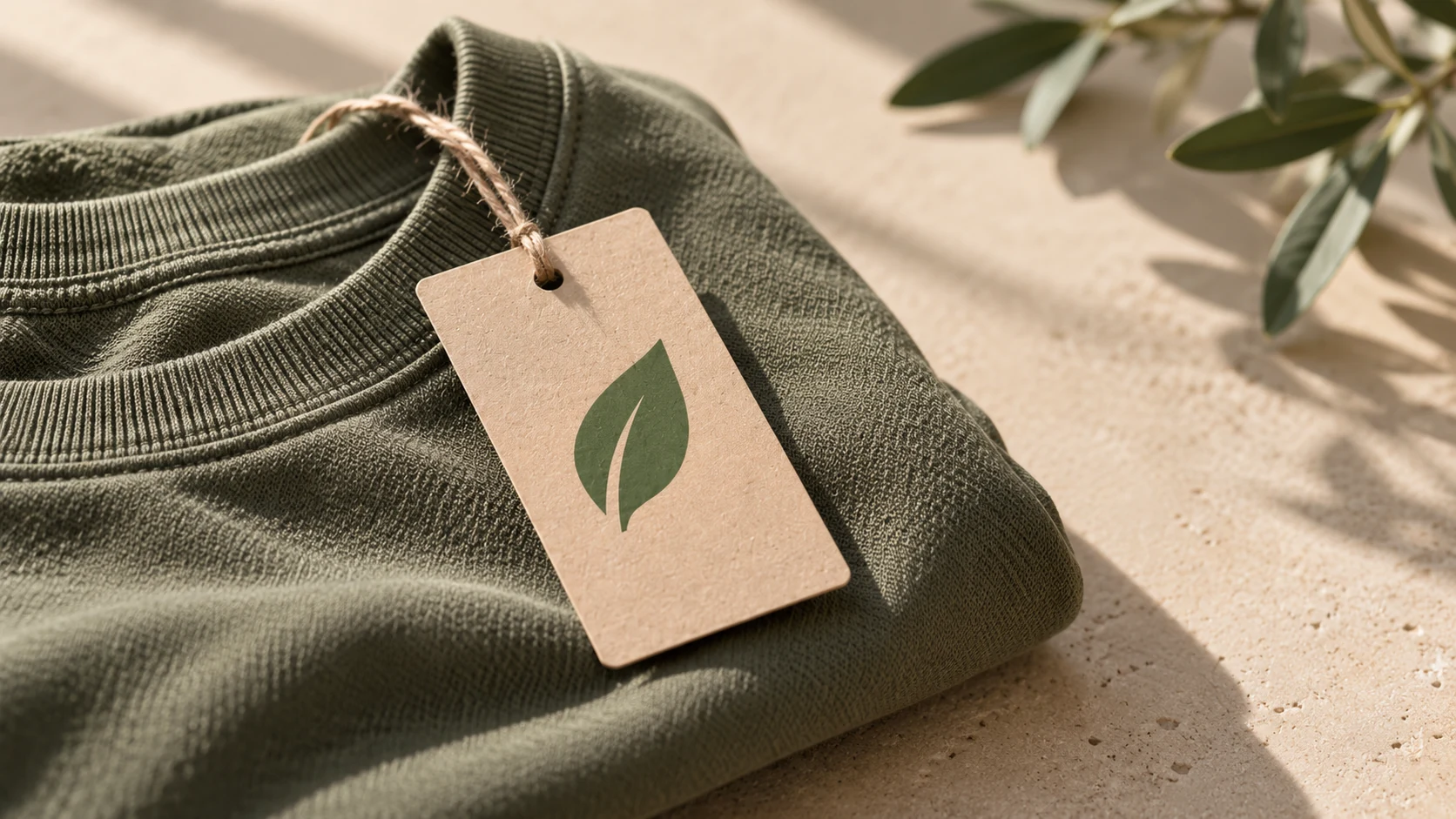
In practice, this means the question is no longer only what your packaging says. It is also what your packaging suggests. A leaf, a globe, a water droplet or a green colour field can all imply environmental benefit, and where they do, they fall inside the definition.
An environmental claim of any kind is assessed under the general rules on misleading practices. It has to be accurate, and it must not create a false overall impression, even when every individual word on the pack is true.
When an image turns a vague word into a banned claim
The directive treats one type of claim far more strictly than the rest. A generic environmental claim is an environmental claim made in written or oral form, not included on a sustainability label, where the specification of the claim is not given clearly and prominently on the same medium.
Generic claims go on the list of practices that are prohibited in all circumstances. Under Annex I, point 4a, a trader may only make one if it can demonstrate recognised excellent environmental performance relevant to the claim. The directive defines that narrowly as compliance with the EU Ecolabel, an officially recognised EN ISO 14024 type I ecolabel, or top environmental performance under other EU law.
An image on its own is not a generic claim, because the definition covers written and spoken claims. Recital 9 explains what happens when the two meet: a written or oral claim combined with implicit claims such as colours or images could constitute a generic environmental claim.
This is where design becomes a legal question. The word "green" on a swing tag is already risky. The same word set beside a leaf and a field of green is more likely to read as a broad promise of environmental excellence, which is exactly what the ban targets.
The directive's own examples of generic claims include "environmentally friendly", "eco-friendly", "green", "nature's friend", "ecological", "climate friendly" and "biodegradable". Recital 10 adds that words such as "conscious", "sustainable" and "responsible" cannot be justified by environmental performance alone, because they also imply social characteristics.
Most recycled-content certifications, including widely used textile standards, are not recognised excellent environmental performance in this sense. Holding a certification does not by itself make a generic word permissible.
How to keep the imagery
The directive does not ban leaves, green palettes or nature photography. It bans vague promises that cannot be backed by recognised excellent performance. The way out is specificity.
Recital 9 states that when the specification of an environmental claim is given clearly and prominently on the same medium, such as the same advertising spot, the product's packaging or the online selling interface, the claim is not considered generic. The directive's own example contrasts "climate-friendly packaging", which is generic, with a statement that all of the energy used to produce the packaging comes from renewable sources, which is specific.
For a recycled product, the same logic applies. "Eco-friendly fabric" next to a leaf is a generic claim. A stated recycled content percentage for the fabric, printed on the same tag as the leaf, gives the consumer a specific, checkable fact.
Two conditions still apply to specific claims. The specification has to be on the same medium, so a figure buried on a website does not rescue a vague word on the pack. The specific claim must also be true and substantiated, because it remains subject to the general rules on misleading practices.
The claim also has to match its scope. Annex I, point 4b, prohibits an environmental claim about the entire product when it only concerns one aspect of it. The directive's example is a product marketed as made with recycled material when only its packaging is recycled. If only the outer fabric is recycled, the tag should say so.
A five-point check for packs, swing tags and mailers
Run these questions across every consumer-facing surface, including packaging, swing tags, e-commerce mailers, product pages and paid social creative.
- Does the design imply an environmental benefit? Look for leaves, globes, water droplets, recycling-style arrows, earth tones and green colour fields that are there for effect rather than to convey mandatory information.
- Is that imagery next to a vague word? Check for terms such as "green", "eco-friendly", "conscious", "sustainable" or "planet-friendly" near the image.
- Is the specific claim on the same medium? If there is a vague word, the specification needs to be stated clearly and prominently on that same pack, tag or page, for example a stated recycled content percentage.
- Does the claim match its scope? A claim about the whole product must not rest on one component, such as the packaging or a single fabric panel.
- Can you produce the evidence? Every specific claim should be traceable to a document you could hand to a regulator, a retailer or a competitor who challenges it.
For a wider self-audit of wording, labels and future-performance claims, use our EmpCo green claims checklist. Labels themselves follow separate rules, covered in which sustainability labels EmpCo allows.
Giving the leaf something specific to sit next to
The directive applies to claims made to consumers, so the legal responsibility sits with the brand. The evidence behind those claims, however, usually starts with the material supplier.
For rPET, Waste2Wear measures recycled content with RA3, our patent-pending, in-house method, which gives an exact percentage rather than an estimate. The methodology was validated by the independent laboratory Wessling in 2021, and Wessling can validate an individual result on request.
That figure is the kind of specification the directive rewards. A brand can print a stated recycled content percentage beside its imagery and point to the testing behind it, instead of relying on a vague word it would struggle to defend.
If you are reviewing your packs and tags ahead of the new rules and want to know what evidence we can supply for your order, contact our team. For the full picture of what EmpCo changes for recycled textiles, read our guide to EmpCo green claims.